
From Hand Drawing to Global Shipping: A Custom Order's Route
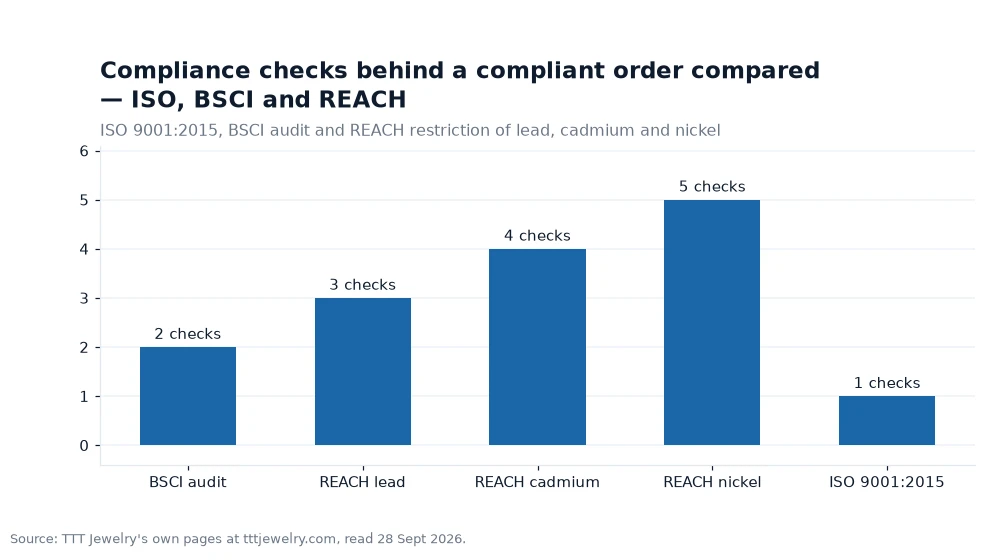
A custom order passes five compliance checkpoints before cartons leave: ISO 9001:2015, a BSCI audit, and three REACH restrictions covering lead, cadmium and nickel. The physical route between them runs 48 hours of CAD, 25–30 days of sampling and 3–4 weeks of production, which is 48–60 days end to end. Each handover on that route creates a document, and the documents are what make the route repeatable.

Key takeaways
- The full route is 48–60 days: 2 days of CAD, 25–30 days of sampling, 21–28 days of production.
- Five compliance checkpoints sit along it — ISO 9001:2015, BSCI, and REACH limits on lead, cadmium and nickel.
- Sampling is five bench operations; production is 3–4 weeks once the sample is approved.
- Final QC is 100% inspection, followed by branded packing and global shipping.
The route in one line
Concept design begins as a hand drawing and a CAD model, becomes a physical prototype, is cast, cut from its sprue, polished, textured and plated, then inspected, packed and shipped. Eight factory steps, six project stages, one route. TTT Jewelry has run that route as an OEM/ODM manufacturer since 2010, and publishes the same sequence on its own pages, which makes it possible to follow a single order from the first sketch to a tracking number without guessing at the middle.
What changes between orders is not the route but the load on each part of it. A simple band moves through setting quickly and spends its time in polishing and plating. A stone-set pendant spends longer at the setter and needs a second look at the prongs before plating. A collection with five designs multiplies the bench time but shares the CAD and the approval meeting. Planning starts by deciding which step will be the constraint, then protecting that step from revision requests.
Paper to CAD: the first translation
A hand drawing carries proportion and intent, not dimensions. The CAD stage turns it into a model with wall thickness, seat geometry and findings, and TTT Jewelry completes that work in under 48 hours with realistic renderings for sign-off. The renderings are the buyer's only chance to see the piece at scale before metal exists, so the useful review is specific: band width in millimetres, stone diameter, drop length, clasp type. Comments such as "make it more elegant" cannot be modelled and will return as a question.
This is also where the IP position is set. TTT Jewelry states 100% NDA cover and that designs, moulds and CAD files stay exclusive to the brand and are not resold. For a private label programme, that matters twice: once at launch, when the shape is the differentiator, and again in season three, when the same shape has to be reordered without a competitor carrying it. A supplier working as a OEM/ODM jewelry manufacturer should be able to state that exclusivity in the quotation rather than in a conversation.
The bench route and the records it leaves
From the model, the order enters the bench sequence: prototyping by mould or 3D printing, sprue cutting, polishing, surface art and electroplating. Each stop leaves something behind. Prototyping leaves the approved sample. Sprue cutting leaves a cleaned casting. Polishing leaves a finish that can be photographed under raking light. Surface art leaves a texture reference. Electroplating leaves a colour standard, whether that is 14K, 18K or 24K gold, rhodium, or PVD on stainless steel. None of these records is glamorous, and all of them are what a buyer needs when a reorder has to match the first run.
| Checkpoint | Record created | Checked when |
|---|---|---|
| CAD and prototype | Model file and signed render | Before sampling |
| Sample approval | Physical sample and comments | End of 25–30 days |
| Plating standard | Colour and finish reference | Before bulk run |
| Final QC | 100% inspection record | Before packing |
Compliance rides alongside those handovers rather than at the end. ISO 9001:2015 covers the management system that keeps each stage to its setting. The BSCI audit covers labour practice at the bench. REACH covers the material itself, with lead, cadmium and nickel named as restricted, and TTT Jewelry states that its materials are free of all three and that plating complies with REACH and CA Prop 65. A brand that collects those documents at the start of the route avoids the common failure of a finished batch waiting on paperwork. For a private label jewelry manufacturer, those four records are also the reorder file: the next run can be matched to them without reopening the design.
Inspection, packing and the last gate
Final QC is described as 100% inspection, which means every piece rather than a sample. The inspection looks for the faults the earlier steps could have hidden: a short-filled edge from casting, a prong that sits off the stone, a polish mark inside a curve, a plating shadow on the underside of a link. At this point a fault can still be reworked or the piece remade, which is why the gate sits before packing and not after.
Packing is a production step in its own right. TTT Jewelry lists metallic logo tags, foil-stamped gift boxes, velvet or microfiber pouches, display backing cards and barcode labelling. Each one is a separate item to specify, and a missing barcode file can hold a finished order longer than a plating fault. Delivery closes the route with global shipping and customs support, and the brand's first sight of the product is a carton that either matches the approved sample or does not.
Worked example
Count the five compliance checks and split them by type. ISO 9001:2015 is check 1, BSCI is check 2, and REACH supplies checks 3, 4 and 5 for lead, cadmium and nickel. Three of the five checks (3 ÷ 5 = 60%) concern substances in the product; two of the five (2 ÷ 5 = 40%) concern the system and the workplace. Now add the clock: 2 days of CAD + 25–30 days of sampling + 21–28 days of production gives 48 days at the fast end and 60 days at the slow end. A launch on 1 December therefore needs the brief between 2 October and 14 October, because 60 days back from 1 December is 2 October and 48 days back is 14 October. In weeks, the same band is 48 ÷ 7 = 6.9 to 60 ÷ 7 = 8.6 weeks.
Frequently asked questions
How long does a private label order take end to end?
48–60 days in total: under 48 hours for 3D CAD, 25–30 days for master sampling and 3–4 weeks for mass production. That is roughly seven to nine weeks.
When does the brand see the design before production?
At the CAD and prototype stage, which TTT Jewelry completes in under 48 hours with 3D drawings and renderings for dimensional sign-off.
What is inspected before shipping?
Every piece, since TTT Jewelry describes final QC as 100% inspection, followed by branded packaging and worldwide express shipping.
Planning backwards from a launch date
Take the ship date and subtract the route in reverse: packing and dispatch, then 21–28 days of production, then 25–30 days of sampling, then two days for CAD. The result is the latest date a brief can arrive and still make the launch. If that date has already passed, the honest options are a smaller first drop or a later launch, not a shorter sample. For repeat shapes already in the range, the custom jewelry wholesale path removes the sampling block and leaves production as the only long stage. The route does not become shorter; one part of it is simply already done.
Source note: figures come from the manufacturer's own website (tttjewelry.com), read 28 Sept 2026.[1]