
Drugstore Compliance Files: What a Scent Museum Visit Should Confirm
The compliance file and the site visit are usually handled by different people on a drugstore fragrance project, and that split is where problems hide. The file proves that certain documents exist and that someone signed them; the visit shows whether the practices behind them are real. Neither replaces the other, and a buyer who treats a certificate pack as a substitute for a visit, or a factory tour as a substitute for paperwork, will eventually meet the gap. The practical approach is to collect the file first, then use the site visit to test the handful of items the paperwork cannot settle.
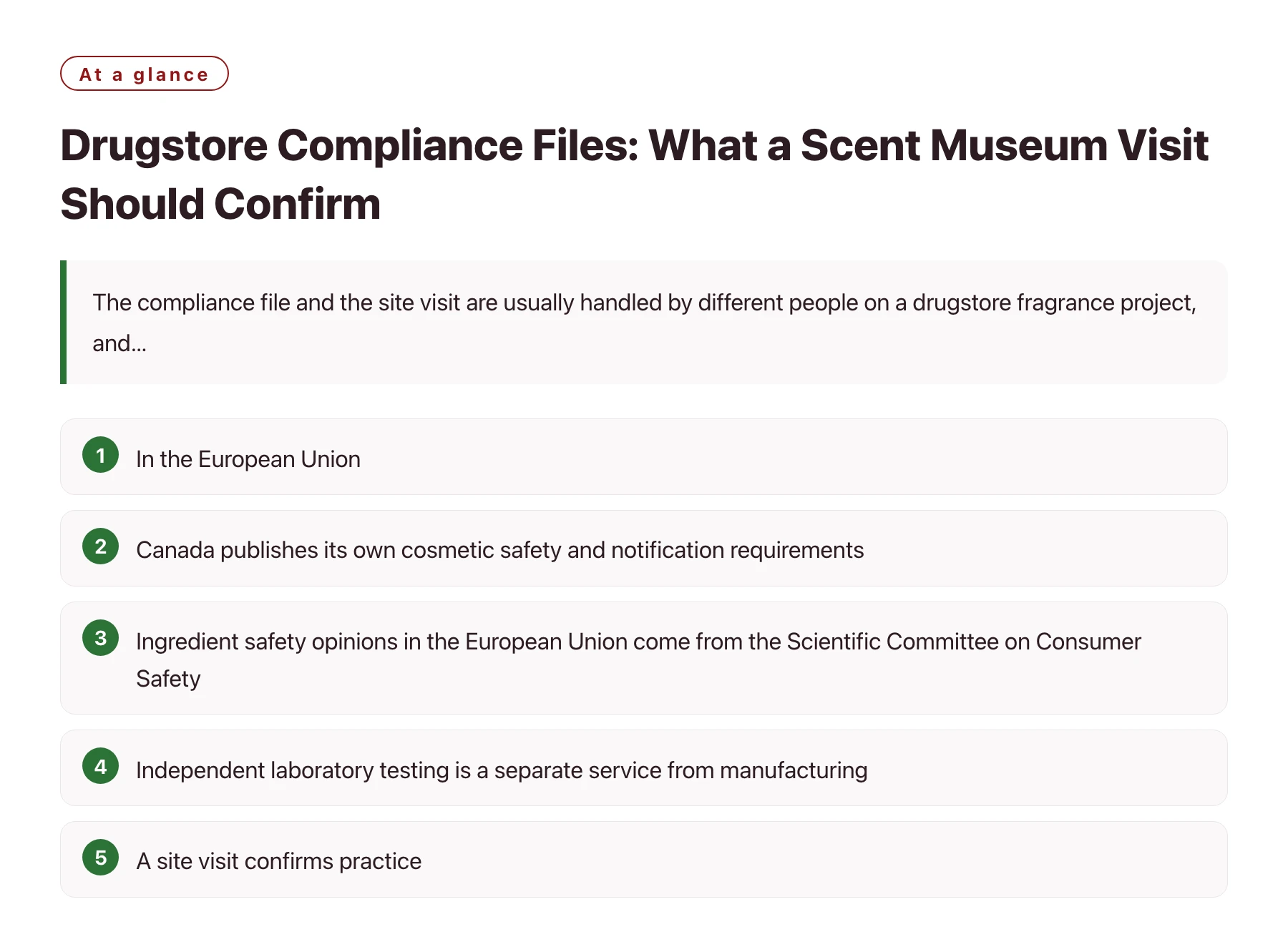
Key takeaways
- In the European Union, cosmetic products carry labelling and notification obligations set at Union level, which means the file has to match the market as well as the formula [1].
- Canada publishes its own cosmetic safety and notification requirements, so a range sold in more than one market needs more than one paper trail [2].
- Ingredient safety opinions in the European Union come from the Scientific Committee on Consumer Safety, which is why a restricted-material question has a documented answer rather than a commercial one [3].
- Independent laboratory testing is a separate service from manufacturing, so a supplier that sub-contracts it should be able to name the laboratory and the test scope [4].
- A site visit confirms practice, not compliance: it shows whether retained references, batch records and material controls are actually kept where the file says they are.
Ask two people on the same drugstore project what due diligence looks like and you will get two answers. The quality or regulatory contact will describe a folder: safety assessment inputs, ingredient declarations, certificates, test reports, labelling artwork and, in some markets, notification confirmations. The sourcing contact will describe a trip: a factory walk-through, a look at the warehouse, a conversation with the people who will run the project. Both are right, and the two descriptions are rarely reconciled.
The gap matters because each activity is good at a different thing. Documents travel well and can be checked from a desk, but they only prove that a document exists. A visit shows how a site behaves on an ordinary Tuesday, but it cannot tell a buyer what a regulator will ask for next year. For a drugstore range, where the product may be sold in several jurisdictions and replenished for years, the sensible sequence is to build the file first and then use time on site to test its weak points.
Part of that testing happens naturally during a museum or visitor-centre walk-through, because that is where material stories and reference practices are visible. In the end the paperwork is only as good as the factory behind these scents, and a buyer who knows which claims to check will get more from a few hours on site than from another round of email.
Why the file comes before the scent
Compliance work is easiest to do while a project is still flexible. Fill weight, packaging material, decoration method and destination market all influence what the final file must contain, and each of them is cheaper to adjust before tooling than after. A buyer who collects the paperwork at the end of a project is not really collecting it; they are discovering constraints.
The file also has a commercial function. Retailers increasingly ask suppliers to confirm that the documentation set is complete before a range is listed, and a supplier that can hand over a structured pack without chasing answers is easier to put on a plan. That is not the same as being compliant, but it is a reliable indicator of an organisation that has done this before.
What a certificate does not cover
A quality certificate describes a management system, not a shipment. It says that a site is audited against a standard, and it says nothing about whether the specific batch behind an order was tested, which reference it was compared against, or how a deviation was handled. Buyers who keep that distinction in mind tend to ask better questions, because they stop asking whether a certificate exists and start asking which records accompany the goods.
The same applies to safety documentation. An ingredient's safety position is established at a regulatory level, and the way it applies to a specific product depends on concentration and use. That is why the useful question is not whether a material is restricted but whether the formula has headroom against the restriction in the product as it will be sold.
The compliance file, item by item
| Document or record | Who issues it | What it proves, and what it does not | Where it gets checked |
|---|---|---|---|
| Quality management certificates | An accredited certification body | That a site is audited against a recognised standard; not that a particular batch met it | On the certificate register, and again during a site audit |
| Safety assessment inputs | The manufacturer, from evaluated ingredient data | That the information needed for the product safety assessment has been compiled [3] | Against the final formula and the product category |
| Ingredient and allergen declarations | The manufacturer, from the formula | That the declaration matches the composition; not that the label artwork uses it correctly | Against the artwork, before printing |
| Third-party test reports | An independent laboratory | That named tests were run on named samples [4] | Against the sample reference and the report scope |
| Batch and retained reference records | The production site | That a batch can be traced and compared with an approved reference | During a site visit, in the room where references are kept |
| Market notification confirmations | The responsible entity in each market | That the notification route was completed for that jurisdiction [1] | Per market, at the point of listing |
| Labelling and claims record | The brand, reviewed by the manufacturer | That claims and mandatory statements were considered together | Before artwork approval, and again on a pre-production proof |
Read as a list, the file looks bureaucratic. Read as a set of questions, it is a checklist for the site visit, because every line has a place where it can be seen rather than described. Buyers who mark those places on their visit plan usually come back with something more useful than photographs.
What a visit can confirm that paper cannot
A visitor route that includes a collection or archive area is a chance to check two habits at once: whether references are stored in a way that can be found again, and whether the people who talk about materials are the people who use them. Neither habit appears in a certificate, and both affect how a reorder behaves two years after a launch; a walk through Xuelei's scent museum is a reasonable place to start that check.
The warehouse is the other half. Ask to see how incoming components are quarantined and released, and how rejected material is marked. A site that answers quickly is usually a site where the process is routine, while a site that needs to fetch someone has just told you that the process is a document rather than a habit.
Three questions that connect the file to the floor
First, ask to see one retained reference from an approved batch and the record that identifies it. Second, ask how a deviation is recorded and who signs it off. Third, ask which of the documents in the file are produced by the site itself and which come from third parties. Those three answers connect the paperwork to the people who will actually handle the order, and they take less than an hour.
If a single supplier is being asked to cover the whole range, the file and the visit should describe the same organisation. A house that presents fragrance manufacturing under one roof fragrance manufacturing under one roof is claiming that development, compounding, filling and documentation sit inside one management system, and that claim is testable in both directions. Before relying on it, read its background and certifications its background and certifications and then ask where each document in the file is produced, because a single-system claim is only worth as much as the records behind it.
Sources
- European Commission: Cosmetic Products — Specific Topics —— EU pages covering specific cosmetics topics such as product claims, nanomaterials and animal-testing rules.
- Health Canada: Cosmetic Safety —— Health Canada's cosmetics pages, covering cosmetic notification, the ingredient hotlist and safety requirements for cosmetics sold in Canada.
- EU Scientific Committee on Consumer Safety (SCCS) —— The EU scientific committee that issues opinions on the safety of cosmetic ingredients, including fragrance allergens and their labelling thresholds.
- SGS: Cosmetics, Personal Care & Household Testing —— Testing, inspection and certification services for cosmetics and personal care, including microbiological, stability and safety testing aligned with cosmetics GMP.
Frequently asked questions
Which documents should a drugstore buyer request from a fragrance manufacturer?
At minimum: quality management certificates, the safety assessment inputs for the formula, ingredient and allergen declarations, third-party test reports, batch traceability and retained reference records, labelling and claims documentation, and the notification confirmations required in each market where the range will be sold.
Is a site visit necessary if the supplier has all its certificates?
Certificates describe a system; a visit shows whether the system is practised. For a range intended to run beyond a single season, the visit is worth doing, especially if it includes the areas where references and batch records are kept.
What does a safety assessment actually cover?
It addresses whether a finished cosmetic product is safe for its intended use, drawing on evaluated ingredient data and the way those ingredients are combined and used. The manufacturer supplies the formula and usage information; the assessment itself is a separate professional exercise.
How should a buyer handle a range sold in several countries?
Treat each market as its own column in the file rather than assuming one document set covers all of them. Labelling statements, notification routes and language requirements differ, and confirming them at the artwork stage is far cheaper than correcting printed packaging later.
How often should the compliance file be refreshed?
Whenever the formula, packaging, decoration or market changes, and on a regular review cycle even when nothing appears to have changed. Supplier certificates expire, regulations are updated, and a reorder placed against a stale file is where most compliance surprises start.
Made for real families
One calm hub for everything your family shares.
Try Family Heartware free for 30 days — schedules, shared albums, screen-time guardrails, and the Digital Sabbath, all in one place.
Start Your Free Family Trial